Contents 9 sections
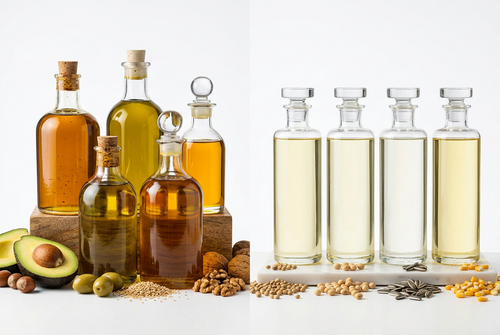
Plant oils are versatile natural raw materials. But not all oils are the same: depending on their composition, their properties differ considerably.
A key factor is the fatty acid profile. Chain length and the number and position of double bonds influence, among other things, the reactivity and oxidative stability of an oil.
When assessing plant oils, it is therefore worth taking a closer look at their fatty acids.
What are fatty acids?
Fatty acids consist of a chain of carbon atoms. They differ mainly in their chain length and their degree of saturation, i.e. the number of double bonds.
This structure is expressed in shorthand:
C12:0 = 12 carbon atoms, no double bond
C18:1 = 18 carbon atoms, one double bond
C18:2 = 18 carbon atoms, two double bonds
Depending on their structure, fatty acids belong to different groups.
Saturated or unsaturated?
Saturated fatty acids have no double bonds. Examples include lauric acid, palmitic acid and stearic acid. Lauric acid is found, for example, in coconut and palm kernel oil.
Monounsaturated fatty acids have one double bond. An important example is oleic acid (C18:1), which occurs in olive, almond, hazelnut and apricot kernel oil, among others.
Polyunsaturated fatty acids have two or more double bonds. These include, for example, linoleic acid (C18:2) and alpha-linolenic acid (C18:3).
As a general rule, the more double bonds a fatty acid has, the more reactive it is.
What role does chain length play?
The length of the carbon chain is also an important structural feature.
Among other things, the source distinguishes between:
| Fatty acid type | Chain length |
|---|---|
| short-chain | 4–6 carbon atoms |
| medium-chain | 8–12 carbon atoms |
| long-chain | usually 14–18 carbon atoms |
| very long-chain, polyunsaturated | usually 20–26 carbon atoms |
Chain length and degree of saturation are therefore two important criteria for classifying fatty acids and the composition of oils.
Omega-3 and omega-6
In unsaturated fatty acids, the position of the double bond also plays a role.
This is described using omega nomenclature, counting from the methyl end of the fatty acid.
Examples:
Alpha-linolenic acid → omega-3
Linoleic acid → omega-6
The omega designation thus complements the information on chain length and number of double bonds.
Which fatty acids characterise plant oils?
Plant oils consist of characteristic mixtures of different fatty acids. A particular fatty acid or group of fatty acids often predominates.
| Fatty acid | Typical plant oils |
|---|---|
| Oleic acid | Olive, almond, hazelnut |
| Linoleic acid | Sunflower, safflower, grapeseed |
| Alpha-linolenic acid | Linseed, perilla, hemp |
| Gamma-linolenic acid | Borage, blackcurrant seed, evening primrose |
| Palmitoleic acid | Avocado, macadamia, sea buckthorn pulp |
There are also special fatty acid profiles, for example in pomegranate seed oil or algae oil. Combined profiles – such as oleic and linoleic acid – also characterise certain plant oils.
Why are double bonds important for stability?
As a rule, as the number of double bonds increases, so does the susceptibility to oxidation.
The source gives the following relative factors:
| Fatty acid type | Example | Relative factor |
|---|---|---|
| saturated | Lauric acid | 1 |
| monounsaturated | Oleic acid | 100 |
| diunsaturated | Linoleic acid | 1,200 |
| triunsaturated | Linolenic acid | 2,500 |
The values serve as a relative guide. At the same time, the source points out that natural minor lipid constituents can influence oxidation differently depending on the oil.
In practice, this means that oils with a higher proportion of polyunsaturated fatty acids are generally more sensitive and require appropriate care during storage and processing.
The fatty acid profile alone is not enough
A plant oil does not consist of fatty acids alone.
Natural oils also contain various minor lipid constituents, such as tocopherols, phytosterols, squalene, carotenoids or lecithin. These constituents can help shape the properties and stability of an oil.
This is why two plant oils can differ considerably despite similar fatty acid profiles. When assessing raw materials, it is always the overall profile that counts.
What matters when selecting raw materials?
For a professional assessment of plant oils, several levels are therefore of interest:
Fatty acid profile – Which fatty acids predominate?
Chain length and degree of saturation – How are the fatty acids structured?
Minor lipid constituents – Which natural minor constituents does the raw material bring with it?
Oxidative stability – How sensitive is the oil phase?
Only the interplay of these factors gives a plant oil its individual profile.
Conclusion
Fatty acids are an important key to understanding plant oils. Chain length, double bonds and their position shape the structure and thus important properties of the fatty acids they contain.
At the same time, plant oils are complex natural products. In addition to the fatty acid profile, the natural minor lipid constituents also play an important role.
For professional raw material and product development, it is therefore always worth looking at the oil’s overall profile – not just at a single fatty acid.
Quoted from Ruth von Braunschweig: Plant oils. Über 50 starke Helfer für Genuss und Hautpflege!. Stadelmann Verlag, 2025. Chapter VII ‘Fatty Acids’, pp. 283–289.. ISBN 978-3-943793-68-0 – By kind permission of Stadelmann Verlag.